Coverage design & RF planning
We model your ground against elevation data before anything gets mounted — where the nodes go, how many you need, and what each hop actually buys you. The same terrain tooling behind our mapping apps.
We design, install, and maintain LoRa mesh radio networks — text, GPS, and sensor data across miles of country with no cell service, no internet, and no monthly bill. Built for ranches, work sites, and search teams in the high country.
A mesh isn't a cell network and it isn't a repeater on a hill. Every radio is both an endpoint and a relay — so coverage grows as you add nodes, and the network routes around whatever breaks.
There's no central tower. Each node receives a packet, checks whether it's already seen it, and rebroadcasts it. A message walks node-to-node until it reaches its destination — so two radios that can't hear each other still talk, as long as something sits between them.
LoRa trades bandwidth for distance. Ridge-to-ridge you can see many miles on a few hundred milliwatts; down in the timber it's far less. We plan node placement against the actual terrain so the hops land where the country allows, not where the brochure says.
Lose a node to a dead battery, a snow load, or a truck backing into the pole, and traffic re-routes through whatever path remains. Redundancy is a design choice we build in from the start, not a feature you buy later.
Traffic rides on AES-256 pre-shared-key channels. Separate channels keep crews, family, and operations apart on the same hardware — the ranch channel and the guide channel don't have to see each other.
Beyond text: GPS beacons so you know where the crew is, plus telemetry from tank levels, gate sensors, weather, and battery state. The same mesh that carries a message carries the numbers you'd otherwise drive out to read.
A repeater on a ridge is a panel, a battery, a radio, and an antenna in a weatherproof box. Sized correctly for a Colorado winter, it runs through the dark months without a visit — and reports its own battery health so you know before it doesn't.
No carrier, no internet, no power grid, no subscription. When the road closes and the tower goes down, the mesh is unaffected — which is exactly why it's worth installing before you need it.
From a first site walk to the seasonal service visit years later. Hardware is specced to your terrain and budget — supplied by us, or sourced by you if you'd rather buy direct.
We model your ground against elevation data before anything gets mounted — where the nodes go, how many you need, and what each hop actually buys you. The same terrain tooling behind our mapping apps.
Mounting, antennas, solar and battery sizing, weatherproofing, and grounding — then a live range test across the property so you see the coverage you actually bought, not a prediction.
Encrypted channel setup, key handling, and node roles configured deliberately — client, router, or repeater. Done wrong, one misconfigured node floods the network; done right, you never think about it.
Firmware updates, battery and panel service, node health checks, and callouts when something drops. Networks in this country need a look before winter and a look after it — we schedule both.
Apps and integrations on top of the radios — dashboards, alerting, mapping, and data logging. We've shipped two mesh apps of our own, so this isn't theory.
We modify and build firmware for mesh hardware — custom roles, power and duty-cycle tuning, sensor payloads, and behavior the stock builds don't offer. If the radio won't do what your site needs, we change what the radio does.
Your crew gets shown how to pair a radio, join a channel, read delivery status, and swap a dead node — plus written documentation for the person who takes over after them.
If your operation spreads out past where the phones quit, a mesh is usually the cheapest fix on the table.
Reach hands across pastures and drainages, watch tank and gate sensors, and stop driving the fence line to find out whether someone's fine.
Keep camps, trailheads, and guides in contact through country where a satellite messenger is the only alternative — and a slower one.
Deployable nodes that extend team comms into a drainage for the length of an operation, with positions on a shared offline map.
Crew comms and equipment telemetry for pads, pits, and construction sites well outside carrier coverage.
Staff comms across a property with no signal — the same problem we already solved in software for a Colorado bar with no service.
A community or neighborhood network that keeps working when the grid, the tower, and the road all stop working at once.
Based in North Park, Colorado — we cover Walden and Jackson County first, then out through the surrounding region. Farther afield, or off-corridor entirely? Ask; travel is usually workable.
Most people who install mesh radios are resellers. We build the applications that run on them — two shipped iOS apps that speak these protocols directly, down to the Bluetooth layer.
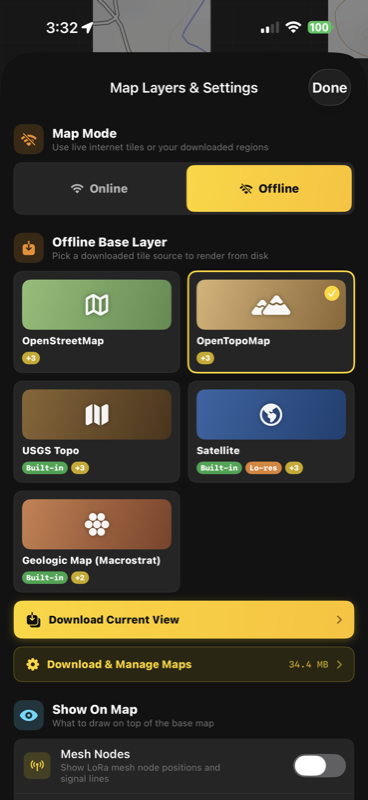
Offline backcountry navigation with native Meshtastic LoRa support — encrypted channels, position sharing, and nine offline map layers, all working with no cell service.
The only app that speaks both Meshtastic and MeshCore at once — one contact list, one map, one inbox, with honest delivery status and an optional forward-secret encryption layer.
A radio costs a few hundred dollars. Getting it onto a ridge that takes a UTV and two hours is the actual job — same as fencing, and ranchers already know this. Here's where it starts.
We walk the property, model it against elevation data, and drive-test it with handhelds. You get a written coverage plan and a node placement map that's yours to keep — whether you hire us to install it, hire someone else, or build it yourself.
| Node type | What it is | Installed |
|---|---|---|
| Handheld radio | Provisioned, keyed, paired to your phone, user trained | $199 |
| Handheld, 5 or more | Same, per unit | $179 |
| Base station | Ranch HQ or command post, grid-powered, external antenna | from $850 |
| Solar repeater — building mount | Ladder-reachable, panel + battery + weatherproof enclosure | from $1,200 |
| Solar repeater — ridge site | 30 ft guyed mast, grounded, hike-in or UTV access | from $1,800 |
| Telemetry sensor node | Water tank, gate, generator, battery state | from $450 |
| Custom firmware | Behavior the stock builds won't do | quoted |
One day on site
A compact place, a lodge and its outbuildings, or a household that wants comms when the grid goes.
Two to three days on site
Covers a few thousand to fifteen thousand acres, depending entirely on how the country lies.
Scoped from survey
Search & rescue, county emergency management, federal land agencies, industrial sites. We can scope to fit a government purchase card.
| Plan | What you get | Cost |
|---|---|---|
| Homestead Watch | Remote monitoring, firmware updates, one service visit a year, phone support | $75/mo · $750/yr |
| Ranch Watch | Monitoring & alerting, two visits a year, priority response, battery & panel service | $175/mo · $1,750/yr |
| Operations | Custom SLA, quarterly visits, spares pool | quoted |
| Out of contract | 2-hour minimum, plus mileage past 30 miles | $125/hr |
// annual prepay saves two months · maintenance is optional, never a condition of the install
// radios on ridges want a look before winter and a look after it — that's what these plans are
The usual alternative is handing every crew member a satellite messenger. Over five years it costs about the same — so the real question is what you get for it.
| 6 satellite messengers | Working Ranch mesh | |
|---|---|---|
| Up front | ~$2,400 | ~$7,500 |
| Every year after | ~$1,800 · forever | $750 · optional |
| Five-year total | ~$11,400 | ~$11,250 |
| Messages | metered, per-message fees | unlimited, free |
| Live map of every hand & truck | no | yes |
| Sensor & tank telemetry | no | yes |
| Still works if you stop paying | no | yes |
// roughly the same five-year money — we're not asking you to spend more, we're asking you to spend it differently
// and one of the two keeps working when the subscription lapses
Carrier satellite messaging now runs about $10 a month per line — and it's free on some plans. It works on a phone you already own, with no hardware to buy and nothing to mount on a ridge. If all you need is "text my wife that I'm running late," go do that instead. We'll tell you so.
A mesh earns its cost when you need things that satellite texting can't do: tank and gate sensors reporting on their own, a live map of where every hand and truck is, unlimited traffic with no per-message metering, comms that work with no carrier account at all, and a network that keeps running when the bill goes unpaid and the tower goes down. If that's not your problem, mesh is the wrong tool and we'd rather say it now than after you've paid us.