Legacy software automation
Industrial and back-office software with no API, no export, and no vendor support. We drive the interface directly — clicking, typing, and reading the screen the way a person would, only reliably and at 3am.
We specialize in automating systems — the copy-paste, the re-typing, the nightly export someone babysits. Including the legacy software everyone says can't be automated because it has no API.
Most automation projects don't start with software — they start with someone describing a task they hate. That's the right place to begin.
Industrial and back-office software with no API, no export, and no vendor support. We drive the interface directly — clicking, typing, and reading the screen the way a person would, only reliably and at 3am.
Move data between systems that were never designed to talk — file drops, databases, spreadsheets, APIs, and instruments. Validated on the way through, so bad rows get caught, not silently imported.
Scheduled reports, invoices, compliance paperwork, and client deliverables generated from live data — formatted the way you already send them, not the way a tool wants to.
Language models put where they genuinely help — classifying incoming work, extracting fields from messy documents, drafting first passes, answering questions over your own technical docs. Never as decoration.
Something watches the thing that matters — a folder, a feed, a gauge, a queue — and tells the right person the moment it goes wrong. Quiet when it's fine, loud when it isn't.
The small custom app that replaces a shared spreadsheet and three side conversations — scheduling, dispatch, inventory, job tracking. Built for how your operation actually runs.
A real shape of engagement, drawn from work already deployed in the field.
Not a demo — software that's been doing a real job on a real site.
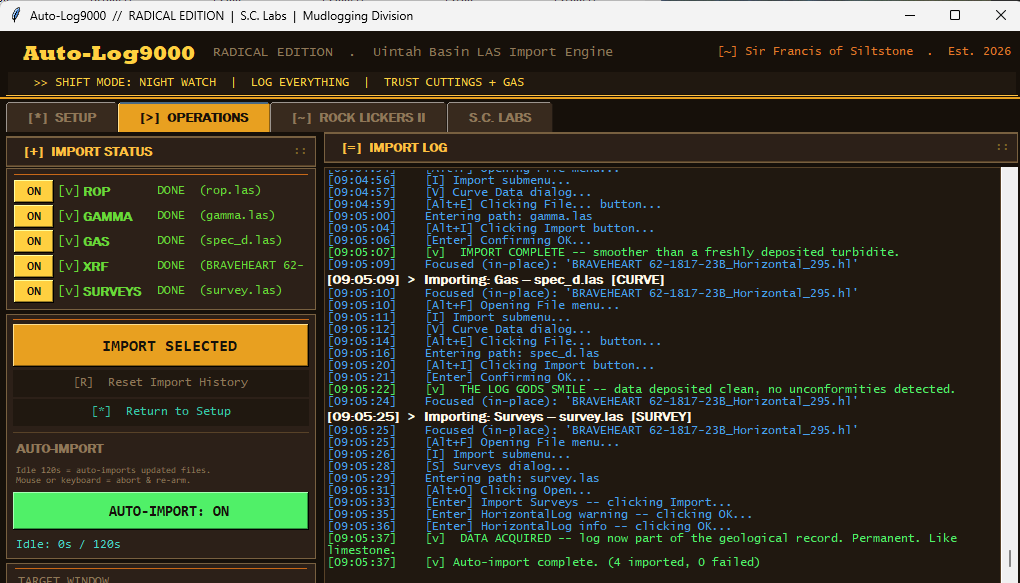
A mudlogging shack runs on constant manual imports. This watches the wireline directory and pulls ROP, gamma, gas, XRF, and survey curves into the geological log every two minutes — automatically, through software with no API, so the logger can watch the rock instead of the keyboard.
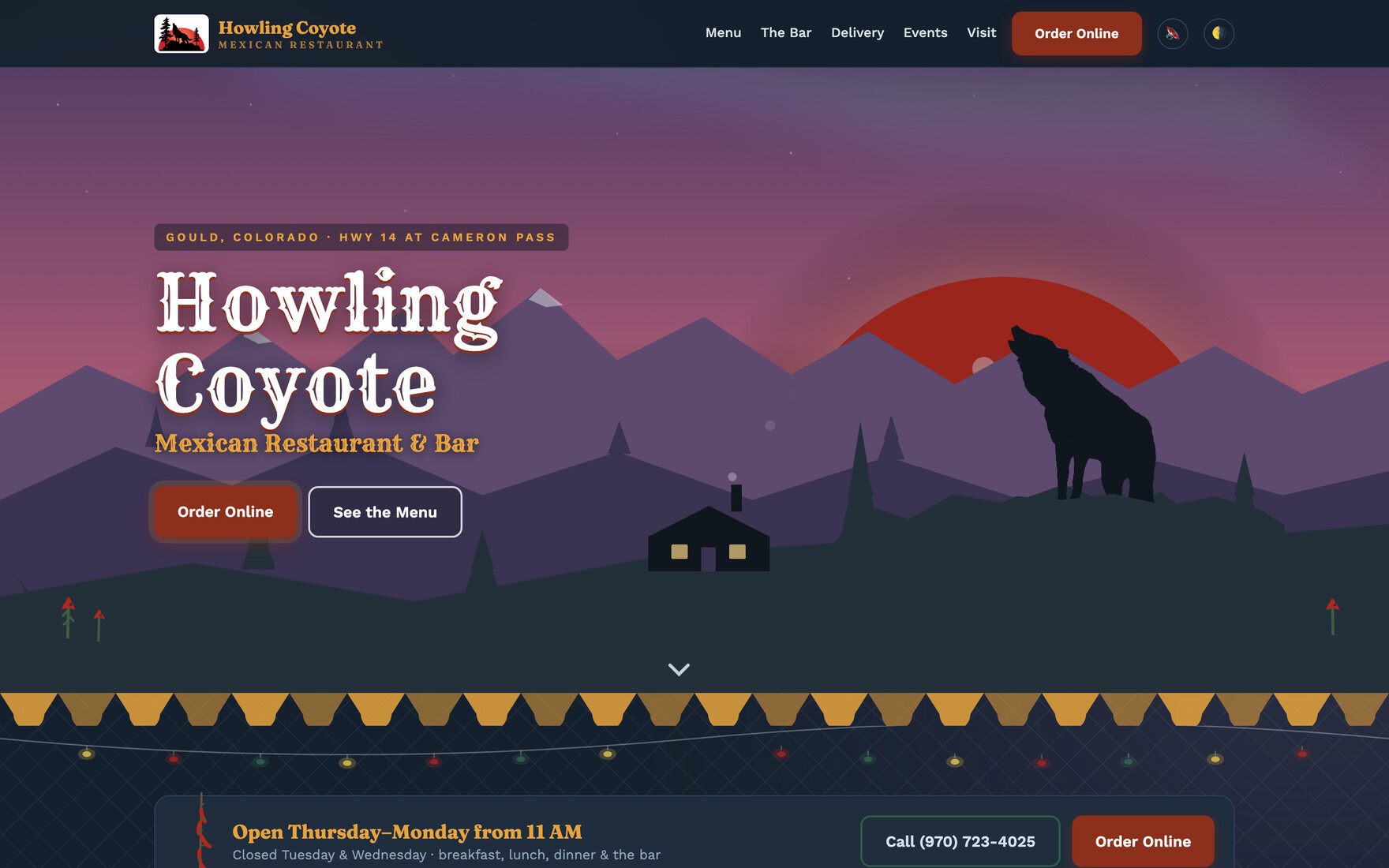
An ordering system for a Colorado bar with no cell service. The menu caches on-device, orders queue in an outbox, and one tap falls back to a text message when data can't get through — the automation is in the failure handling.
Often, yes — and we'll say so. The dividing line isn't simple versus complex. It's whether a failure is cheap to notice and cheap to undo.
| Zapier / Make | Power Automate | Built for you | |
|---|---|---|---|
| Software with no API | Can't — architectural | Desktop RPA, per-bot fee | Yes |
| Retries & error handling | Basic; loops can stop silently | Basic | Built in, alerts a person |
| Won't double-charge on a retry | Not guaranteed | Not guaranteed | Handled explicitly |
| Audit trail you can hand an auditor | Step logs only | Partial | Timestamped, exportable |
| Runs on your machine, air-gapped | Cloud only | Possible | Yes — data never leaves |
| Cost at ~24,000 events/month | Hundreds/mo, metered per step | $150–215/bot/mo | Flat — your hardware |
| Who fixes it at 3am | You do | You do | Us, if you're on a plan |
| One app to another, low volume, cheap to redo | Use Zapier. Seriously. | Overkill | We'd be overcharging you |
// that last row is real — if a $20/month tool does your job, we'll tell you and help you set it up
// we'd rather have the neighbor than the invoice
Send a thank-you email after a Stripe payment? Do it yourself. The tool walks you through it. There's no reason to pay anyone.
Automating a broken process gives you a faster broken process. If the underlying workflow doesn't make sense, fixing that comes first — and it might not need software at all.
We've seen automations that added twenty minutes per customer because nobody asked the front desk why they'd been doing it the old way for twelve years. The fix there is buy-in, not code.
Early on, your own time is the cheapest thing you have. Spend it. Come back when the task is costing you more than the fix.
Automation is one of the few things you can actually do the arithmetic on. We measure the task first, then quote a number that's a fraction of what the task costs you every year.
Half a day watching how the work actually gets done — not how the manual says it does. You get a written findings document ranking what's worth automating, what it would take, and what it would save. Yours to keep either way.
One to two weeks
The single task somebody dreads. Good first project.
Two to four weeks
Where most jobs land — a process, not a task.
Four to ten weeks
Replaces the shared spreadsheet and three side conversations.
Scoped after the audit
Very few people do this work. Auto-Log9000 has been running in a mudlogging shack for a while now.
| Ongoing support | What it covers | Cost |
|---|---|---|
| Watch | Monitoring and alerting, break-fix within a few days | from $200/mo |
| Maintain | Next-business-day response, small changes as you go | from $600/mo |
| Operate | Same-day response, interface-drift repair, monthly report | from $1,800/mo |
| Hourly, out of contract | Changes, additions, one-off fixes | $125–225/hr |
// support is optional — you own the source and can maintain it yourself or hand it to anyone
// automations against software with no API do break when the vendor changes their interface. that's what Operate is for.
No mystery, and no "digital transformation" language. Here's a real shape of a small job.
| Someone spends | 8 hours a week on the task | |
| Their real cost to you | wage + tax + benefits ≈ $30/hr | |
| So the task costs, per year | 8 × 52 × $30 | $12,480 |
| We'd quote roughly a third | one-time, fixed | ~$3,700 |
| It pays for itself in | under 4 months |
// we'll show you this table with your numbers in it before you commit to anything
// and if the honest payback is three years, we'll tell you that and talk you out of it
You show us the task exactly as you do it today. Half of automation is noticing which steps only exist out of habit.
We write down the real process, the edge cases, and what happens when something's malformed — then quote the piece worth automating first.
It runs alongside the manual process on real data until you trust it. No flipping a switch and hoping.
Documented source you own, plus alerting so it tells you when it needs attention. Optional retainer if you'd rather we keep watching it.
Reasonable question for a one-person shop, and the answer is procedural rather than reassuring noises.
You own the source code and every credential from day one — not on request, by default. Everything ships with written documentation good enough for another developer to pick up cold, because that's the actual test. On System-tier work we'll put the code in escrow with a third party who releases it to you on agreed triggers. And nothing we build requires us to run it; if we vanish, it keeps running on your hardware.
You shouldn't want a promise that we'll never disappear. You should want proof that if we did, you wouldn't be stranded.
You don't have to — support is optional and you can maintain it yourself or hand it to anyone.
But here's the honest failure mode. A vendor changes an API token. The workflow stops silently. Nobody notices for six weeks. We've seen a business discover $30,000 in unbilled hours by the time they called someone.
Three boring things break automations: software updates, credential and API changes, and staff turnover changing the process underneath. None of them announce themselves. That's what a plan buys — something watching, and someone who already knows how it works.
Yes. Eventually it will. Anyone who tells you otherwise is selling something.
Software with no API has no contract with us — the vendor can move a button and we find out when it breaks. We build defensively: the automation checks that it's looking at what it thinks it's looking at, and it stops and tells someone rather than doing the wrong thing quietly.
That's precisely what the Operate plan is for. Interface drift is the expected cost of automating software that was never meant to be automated, and it's cheaper than the alternative of doing it by hand forever.
Sometimes, genuinely. For a well-defined task against a modern API, a capable person with an AI assistant and a free afternoon can get there.
What you're actually buying is different: somebody builds it, tests it against the ugly cases, watches it for the first month to be sure, and is accountable when it breaks at 3am. An AI will write you code. It won't notice six weeks later that it stopped working.
Worth knowing: Gartner expects over 40% of agentic AI projects to be cancelled by the end of 2027, and the FTC sued an AI automation company in 2025 over roughly $19 million in customer losses. The technology is real. A lot of what's sold around it isn't.
Weird is normal — most real operations are held together with something nobody would design on purpose.
Too small is a real possibility though, and the audit exists to find out. If the honest answer is that the task doesn't cost you enough to justify fixing, we'll say so and refund the audit. We'd rather return $500 than take $4,000 for something that doesn't pay you back.
Nowhere. That's a genuine difference worth understanding.
Cloud automation platforms move your data through their servers — that's how they work. Zapier is cloud-only and can't sign a HIPAA business associate agreement at all.
What we build runs on your machine, on your network. Your files, credentials, and customer records stay where they are. For anyone handling medical, financial, legal, or commercially sensitive industrial data, that's usually the whole conversation.
Two builds at a time. That's not scarcity marketing — it's the honest capacity of one person who does the work rather than selling it and handing it off.
It means you're talking to the person writing the code, and it means we sometimes can't start immediately. Ask and we'll tell you the real date.
Available for federal, state, and prime-subcontract work. Capability statement, NAICS codes, and registration details are on the capabilities page.